
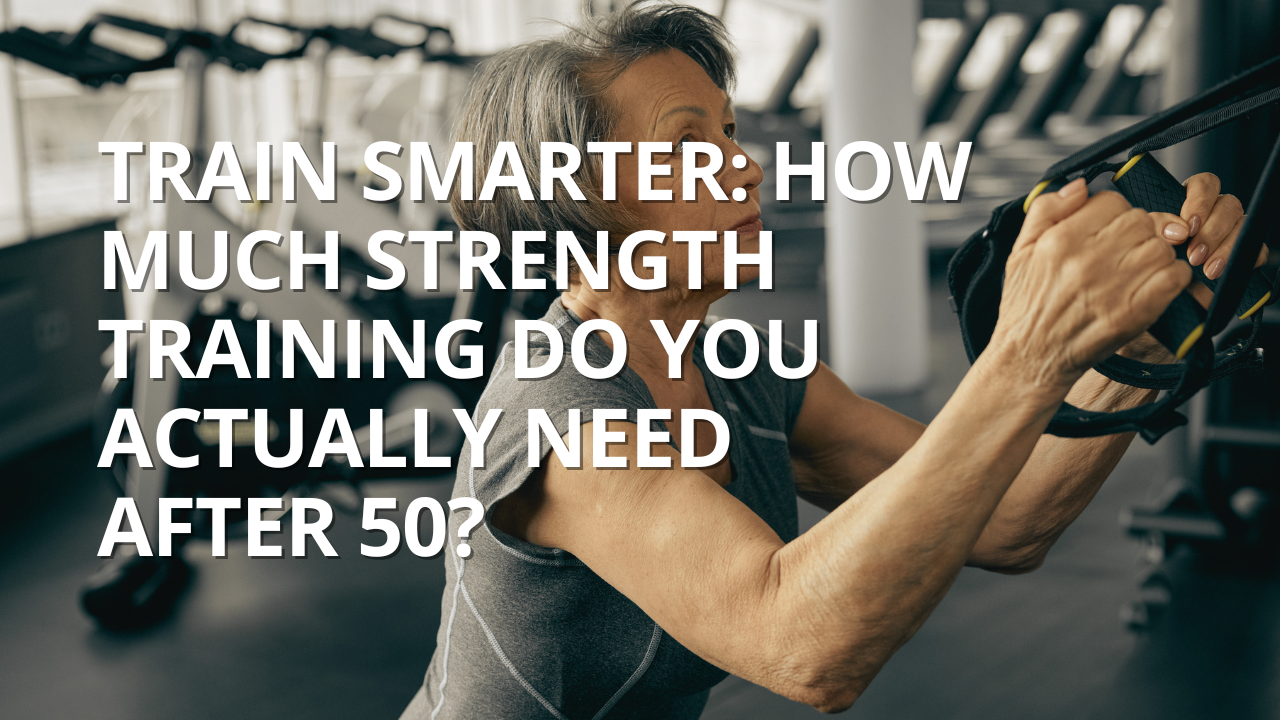
Train Smarter: How Much Strength Training Do You Actually Need After 50?
By Mark Pajich
One of the most common questions people ask is: “How much strength training do I actually need?”
For many adults over 50, the assumption is that staying active through golf, tennis, swimming, walking, or general movement should be enough. While those activities are all valuable, strength training adds something different: it helps preserve muscle, support joints, and maintain the physical capacity needed to keep enjoying those other activities for years to come.
The good news is that you do not need to train every day or spend hours in the gym. In most cases, a well-structured amount of strength work each week is enough to make a real
Why Strength Training Still Matters
After 50, we can lose around 5% to 10% of muscle mass and roughly 10% to 15% of strength per decade. This can affect:
Balance and coordination
Bone density
Joint support
Power and reaction time
Everyday tasks such as climbing stairs, carrying bags, or getting up from a low chair
What Is the Minimum Effective Dose?
For most people over 50, two strength sessions per week is a very good starting point. Each session does not need to be complicated. A focused 30 to 45-minute programme done consistently is often more than enough to be effective.
What Should Those Sessions Include?
A good programme should cover the major movement patterns and muscle groups across the week:
Lower body strength
e.g. squats, leg press, step-ups, split squats
Upper body push exercises
e.g. incline push-ups, chest press, shoulder press
Upper body pull exercises
e.g. cable row, chest-supported row, lat pulldown
Core and trunk control
e.g. Pallof press, bird-dog hold, glute bridge variations
The aim is to train the body in a balanced, repeatable way.
What If You Already Play Sport?
If you already play golf, tennis, badminton, or swim regularly, doing exercises that complement your sport will definitely help you maintain your fitness so that you can continue enjoying it for years to come.
For example:
A golfer may benefit from leg strength, trunk control, and upper back work
A tennis or badminton player may need lower body strength, shoulder support, and rotational control
A swimmer may benefit from postural strength, pulling strength, and hip stability
The best way to know what you need is to complete a fitness assessment that highlights your areas of weakness for your sport.
How Hard Should You Train?
A useful guide is:
Choose a weight or variation that feels challenging by the final few reps
Use a weight that allows you to maintain good form throughout the set
If your technique starts to break down, switch to a lighter weight to finish the set
Two to three sets of 8 to 12 reps work very well for most general strength training goals
A Simple Weekly Example
A balanced week might look like this:
Monday: Strength session
Tuesday: Golf or tennis
Wednesday: Light recovery or cardio exercise
Thursday: Strength session
Friday: Swimming or mobility/flexibility training
Weekend: Sport, walking, or general activity
This gives enough training stimulus to maintain and improve strength, while leaving room for recovery and sport.
Key Takeaway
After 50, you do not need a large amount of strength training, but you do need some.
For most people, two well-structured strength sessions per week is sufficient. It is enough to support muscle, joints, posture, and performance, while still fitting around sport, travel, and everyday life.
Next in the Series
Train Smarter: Why Balance Training Matters More Than You Think After 50
We’ll look at how balance influences confidence, movement quality, and long-term independence, and how to improve it in a practical way.
For more information on our personal training programs, please contact us at 012-334-1511 or send us an enquiry here